

aiQ (ai-quanton GmbH) develops optical measurement technologies for spray diagnostics, droplet measurement, particle characterization, and industrial process monitoring. We combine optical sensors, high-speed signal acquisition, dedicated measurement hardware, software, and artificial intelligence to develop measurement solutions for scientific research and industrial applications.
Our work connects established physical measurement principles with modern AI-assisted signal and image analysis. The objective is to extract more information from optical measurements while developing compact, flexible, and application-oriented measurement systems.
The technology portfolio ranges from classical and AI-based optical spray measurement to advanced material characterization and web-based spray image analysis. Three technology platforms address different levels of spray and particle characterization: SprayQuantAI®, ParticleTensorAI®, and SprayConeAI®.
Technology Platforms
SprayQuantAI®
SprayQuantAI® is an optical measurement platform for dynamic spray diagnostics and industrial spray monitoring. Depending on the measurement configuration, the system can determine parameters such as droplet size, droplet velocity, and droplet number.
SprayQuantAI® combines optical droplet detection with classical and AI-based signal processing. Measurement results can be used for spray characterization, process monitoring, automation, and integration into industrial control environments.
ParticleTensorAI®
ParticleTensorAI® follows a different approach to optical particle and material characterization. Instead of immediately reducing every detected particle event to a small number of numerical parameters, time-resolved light-scattering signals are preserved and combined for AI-based analysis.
This approach makes it possible to investigate additional information contained in the optical signals and to characterize droplets, particles, materials, and dynamic spray processes using multidimensional measurement data.
SprayConeAI®
SprayConeAI® extends the technology portfolio toward web-based spray analysis. Images of spray cones and spray patterns can be evaluated using common digital devices such as smartphones, tablets, and computers.
The approach enables scalable and device-independent analysis of spray geometry and spray patterns without requiring dedicated optical measurement electronics at the point of image evaluation.
Optical Spray and Particle Measurement
Optical measurement systems provide information about droplets, particles, sprays, and multiphase flows without requiring direct mechanical contact with the measured particles. Depending on the measurement method and configuration, relevant parameters can include:
- droplet and particle size
- droplet and particle velocity
- droplet or particle number
- spray distribution
- spray density and dynamic spray behavior
- optical and material-related particle properties
- time-resolved process information
Our research investigates how established optical measurement techniques can be extended through improved signal acquisition, advanced signal processing, machine learning, and artificial intelligence.
From Light Scattering to Measurement Information
A central principle of our optical measurement systems is the conversion of spatial optical information into time-resolved signals. When a droplet or particle passes through a specifically shaped illumination field, its motion transforms the spatial light-intensity distribution into a characteristic time-dependent scattered-light signal.
The temporal structure of this signal contains information about the particle and its interaction with the optical field. Depending on the measurement system, this information can be evaluated using classical physical models, AI-based algorithms, or multidimensional signal analysis.
This concept forms the physical basis for several ai-quanton measurement technologies, including TSTOF, SprayQuantAI®, and ParticleTensorAI®.
Research and Development in Spray Diagnostics
A central focus of ai-quanton is the development of new measurement concepts, prototypes, algorithms, analysis methods, and software platforms for sprays, droplets, particles, and industrial processes.
Traditional optical measurement systems typically transform a detected optical signal into a limited number of parameters such as particle size or velocity. Modern computing methods create the possibility of preserving and analyzing significantly more information contained in the original measurement signal.
For this reason, aiQ develops hybrid measurement approaches that combine established physical measurement principles with machine learning and AI-based analysis. Classical algorithms remain important because they provide physically interpretable measurement quantities, while AI methods can extend the amount and type of information extracted from the same optical measurement process.
These technologies support research and development in fluid mechanics, aerodynamics, coating technology, atomization, spray processes, particle production, process development, and industrial process monitoring.
Industrial Spray and Process Monitoring
Laboratory measurement technology becomes particularly valuable when it can also be transferred into industrial processes. aiQ therefore develops modular measurement architectures that combine optical sensing, signal processing, measurement electronics, software, and industrial interfaces.
Measurement systems can be configured for different applications and can provide relevant process variables to external systems. Depending on the configuration, digital and analog interfaces can support integration with industrial control systems, monitoring infrastructure, gateways, and external software.
This modular architecture allows the same physical measurement principles to be used for experimental research installations, prototype development, and continuous industrial process-monitoring applications.
Modular Measurement Hardware
The measurement platform is divided into optical probes and corresponding control units. The optical probe defines how particles interact with the illumination and which scattered-light information is detected. The control unit acquires and processes the signals and provides the connection to the measurement software and process environment.
Standard optical configurations include the single-channel LSS1, two-channel LSS2, and four-channel LSS4 probes. They are combined with the corresponding ZEON, IMEA, and CLEON control units.
This modular architecture allows related hardware to support different evaluation concepts. The resulting measurement system is defined not only by the optics, but also by signal acquisition, firmware, calculation algorithms, and evaluation software.
Optical Probes | Control Units
Optical Measurement Technology and Expertise
ai-quanton develops customized software and hardware solutions for optical measurement systems, including technologies based on Time-Shift-Time-of-Flight (TSTOF) and LDT. Our work includes the characterization of solid particles, transparent and non-transparent droplets, and complex sprays.
Our development activities combine several technical disciplines:
- optical sensor development
- high-speed data acquisition
- electronic measurement hardware
- light-scattering signal analysis
- machine learning and artificial intelligence
- measurement software and visualization
- industrial interfaces and process integration
- experimental validation with real sprays and particles
This combination helps bridge the gap between scientific measurement technology and industrial applications.
From TSTOF Research to AI-Assisted Measurement
The technological development behind ai-quanton goes back more than a decade. ai-quanton GmbH was officially founded and registered under the name ai-quanton in 2013 as a spin-off originating from research at Technische Universität Darmstadt.
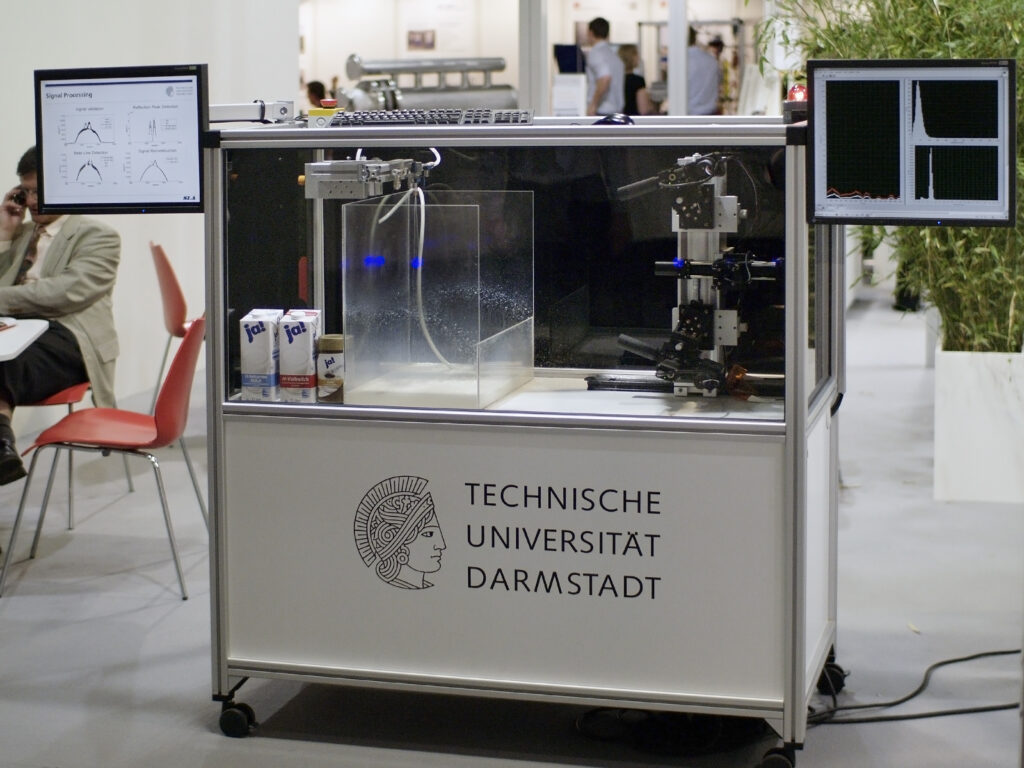
Before the company was founded, Walter Schäfer developed early prototypes of the Time-Shift-Time-of-Flight (TSTOF) measurement technique during his PhD research between 2008 and 2012 [1,3]. Together with Prof. Cameron Tropea, the measurement approach was developed further. An early prototype was presented at ACHEMA 2012 in Frankfurt [2].
Already during this early development phase, the idea emerged to extract more information from optical scattering signals and to use complete signal structures for advanced particle characterization. At that time, however, practical computational resources and machine-learning tools were considerably more limited than today. Classical signal-processing methods therefore formed the foundation of the first measurement systems.
During the spin-off process, the founders also established AOM-Systems. Measurement instruments based on the TSTOF principle were subsequently developed, including systems marketed under the SpraySpy® brand.
With the rapid development and increasing accessibility of machine-learning and AI technologies, new possibilities for evaluating optical measurement data became available. aiQ therefore intensified its development of machine-learning-assisted evaluation of light-scattering signals [6,7]. This work contributed to the development of today’s SprayQuantAI®, ParticleTensorAI®, and SprayConeAI® technology platforms.
Scientific and Industrial Collaboration
Since its foundation, aiQ has worked with universities, research institutes, technology companies, and industrial organizations on scientific and applied measurement projects.
Joint measurement campaigns provide an important connection between theoretical development and practical applications. New concepts can be investigated under realistic conditions using industrial atomizers, sprays, particles, coatings, and production-related processes.
Scientific publications, experimental studies, technical reports, and patent activities document important stages of this development. Research and experimental validation therefore remain central elements of new ai-quanton technologies.
The following overview shows a selection of universities, research institutions, and industrial organizations with whom ai-quanton has collaborated in scientific and applied research activities.
Interdisciplinary Development
Optical measurement technology requires expertise across several technical disciplines. Our interdisciplinary development combines optics, physics, artificial intelligence, mathematics, electronics, hardware development, software engineering, user-interface development, and experimental research.
AI and Signal Analysis
Machine-learning and AI methods are investigated for extracting additional information from optical measurement signals and images.
Optics and Hardware
Optical probes, measurement electronics, high-speed data acquisition, interfaces, and system integration form the physical foundation of the measurement systems.
Software and User Interfaces
Measurement software, web technologies, visualization, and user interfaces make complex optical measurement data accessible for scientific and industrial applications.
Scientific Expertise
Long-standing experience in optical flow, droplet, and particle measurement supports the transfer of established physical measurement techniques into modern AI-assisted diagnostic methods.
Experimental Research
New measurement concepts are tested with real sprays, droplets, particles, atomizers, and industrial processes to connect theoretical development with practical measurement applications.
Research and Technology Development
ai-quanton GmbH concentrates on scientific research, technological pre-development, new sensor concepts, prototypes, measurement methods, AI-assisted analysis, and the transfer of these technologies into practical measurement systems.
The objective is not to replace physical measurement principles with artificial intelligence. Instead, AI is used as an additional tool for extracting information that is difficult or impossible to obtain with conventional signal-processing methods alone.
Scientific Background and Publications
The development of ai-quanton measurement technology is connected to more than a decade of scientific work in optical droplet and particle characterization. The following selected publications, conference contributions, patents, and technical reports document important stages in the development of TSTOF and AI-assisted light-scattering analysis.
[1] Schaefer, W.; Li, L.; Stegmann, P.; Terada, M. Technical Report on the TSTOF Measurement Method: Technical Basics, Historical Development, and Comparison with Other Laser-Based Measurement Methods. Photonics 2026, 13(1), 56. DOI: 10.3390/photonics13010056
[2] TU Darmstadt. Größe und Geschwindigkeit von Partikeln und Tropfen messen. ACHEMA Daily, Frankfurt am Main, Germany, 2012. TU Darmstadt Archive
[3] Schäfer, W. Time-Shift Technique for Particle Characterization in Sprays. PhD Thesis, Technische Universität Darmstadt, Darmstadt, Germany, 2012. Published as a book by epubli, Berlin, 2013, ISBN 978-3-8442-6708-2. Publisher Page
[4] Schäfer, W.; Tropea, C. The time-shift technique for measurement size of non-transparent spherical particles. In Proceedings of the International Conference on Optical Particle Characterization (OPC 2014), Tokyo, Japan, 10–14 March 2014; Proceedings of SPIE, Vol. 9232, 92320H. DOI: 10.1117/12.2063342
[5] Tropea, C.; Schaefer, W. Method and Device for Determining Characteristic Properties of a Transparent Particle. U.S. Patent Application US20170010197A1, 12 January 2017. US20170010197A1 – Google Patents
[6] Schaefer, W.; Li, L. Particle characterization by analyzing light scattering signals with a machine learning approach. Applied Optics 2024, 63(29), 7701–7707. DOI: 10.1364/AO.531346
[7] Schaefer, W. Refractive index determination of dynamic droplets in a flow by analyzing light scattering signals with a machine learning approach. In Proceedings of THMT-25: Turbulence, Heat and Mass Transfer 11, Tokyo, Japan, 21–25 July 2025; Begell House: Danbury, CT, USA, 2025, p. 8. DOI: 10.1615/THMT-25.10